Snapshots before a log

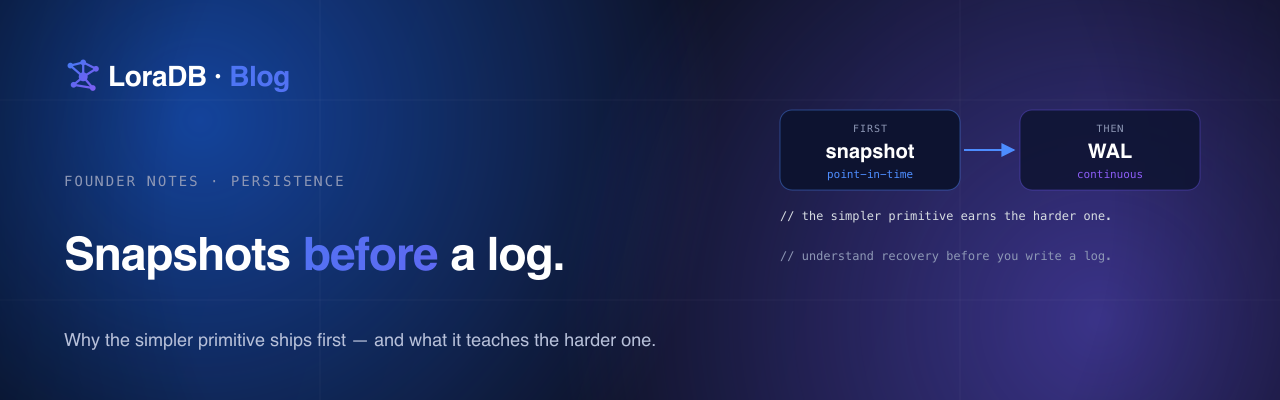
Most databases I have worked with had a write-ahead log before they had a snapshot story. LoraDB went the other way.
This founder note is historical. The WAL has since landed on every
filesystem-backed surface, snapshots now write the columnar LORACOL1
format with compression/encryption support, and WASM uses
saveSnapshot / loadSnapshot instead of the older byte-specific
method names.
At the time, v0.3 shipped manual point-in-time snapshots and nothing else on the persistence side. No append-only log. No background checkpoint loop. No continuous durability. One file on disk, taken on demand, atomic on rename.
The order is intentional, and it is the kind of decision that is easier to defend before the release than after.
The Default Narrative For "Adding Persistence"
The default narrative for adding persistence to an in-memory database is some version of:
- ship a write-ahead log,
- background checkpoints flush state to disk,
- on boot, replay the log on top of the latest checkpoint,
- announce "durable."
That is what mature databases do, eventually. It is also the wrong first step for a project where the data model and the storage tier are both still settling.
A WAL is a long-term commitment to a concrete write path. Every mutation has to know how to serialize itself. Every recovery routine has to dispatch on event type. Every release after the first one inherits the log format, the recovery state machine, and the assumptions baked into both. Get any of that wrong on day one and the project carries the mistake forward — or pays for an expensive migration to fix it.
For a database that is two minor versions old and still figuring out what its read and write paths look like, that is too much surface area to commit to.
What A Snapshot Teaches That A WAL Would Not
A snapshot is the lowest-risk way to learn the shape of "the graph as a serialized artifact." It forces the project to answer a small set of concrete questions:
- What does the file format look like? v0.3 answered with the original
LORASNAPenvelope; current releases writeLORACOL1, a columnar snapshot payload with a BLAKE3 checksum plus compression and encryption metadata. - How is the write atomic?
<path>.tmp,fsync, rename over the target. - How is the read atomic? Hold the store mutex, validate, swap the graph in one shot.
- What does the API look like across every binding?
save_snapshot,load_snapshot,in_memory_from_snapshot, plus an opt-in HTTP admin surface. - What does every binding return? A single
SnapshotMetashape withformatVersion,nodeCount,relationshipCount, and a reservedwalLsn. - What does the operator contract look like?
--snapshot-path,--restore-from, off-by-default admin endpoints, no auth, behind ingress only.
None of those answers went away when the WAL arrived. A checkpoint, by
definition, is a snapshot with a WAL LSN attached. In current releases,
pure snapshots report walLsn: null; checkpoint snapshots stamp it
with the durable WAL fence, and recovery replays committed records
newer than that fence.
In other words, the snapshot work was not throwaway scaffolding. It is the foundation the current log now sits on.
What A Snapshot Is Honest About
A snapshot is not durability. It is point-in-time persistence. The difference matters.
- A crash between two saves loses every mutation in the window.
- The store mutex is held for the duration of both save and load. Concurrent queries block.
- There is no incremental save. The whole graph serializes each time.
- There is no auto-cadence. Saves happen because someone called
save_snapshotor hit the admin endpoint.
That set of caveats is also exactly what makes the primitive useful right now without overcommitting. A single-node service, a notebook, a seeded process, a service with a controlled shutdown window, a backup cron — all of those need the property "the graph as of now, written to one file." None of them need a continuous log to be useful.
The shapes that genuinely need a WAL — multi-node clusters, zero-data-loss writes, mid-second crash recovery — are not the shapes LoraDB is good at today. Building a half-finished log inside a single-process engine ends up with a journal that is less reliable than just snapshotting more often, and worse, with a contract that is harder to read.
Why Honest Boundaries Matter More Than Marketing
The thing I see most often in databases that overpromised on durability is silent data loss between two undocumented seams. That happens when "persistent" is sold as a complete story before the moving parts have settled — when there is durability marketing language without a clean operator contract underneath.
The contract I want for snapshots is small enough to fit on a card:
- The save renames
<path>.tmpover<path>. A crash mid-save can leave the.tmpfile behind. It cannot leave a half-written<path>. - The load swaps the live graph in one shot. Concurrent queries see the old graph or the new one. Never both. Never a partial.
- A crash between two saves loses every mutation in the window. Pick a cadence accordingly.
- The HTTP admin endpoints are off by default. They have no authentication. They are intended to sit behind your ingress.
That is what v0.3 ships. It is the smallest set of guarantees that actually mean what they say. None of them are advertised more aggressively than they are documented.
Where The Persistence Story Goes Next
Three steps line up against the boundary above, in order.
A write-ahead log. This has since landed. Rust and lora-server
expose the full WAL/checkpoint/status/truncate surface; Node, Python,
Go, and Ruby expose container-backed opens plus explicit raw-WAL helpers.
WAL checkpoints are snapshots with a meaningful walLsn, exactly the
shape the snapshot contract prepared for.
Checkpoint automation. Current raw-WAL helpers can write managed snapshots after N committed transactions. The remaining boundary is wall-clock scheduling: if you want time-based checkpoints, run them from the host process, cron, systemd, or an operator loop.
Auth on the admin surface. Token-based auth in front of /admin/*
so the endpoints can be enabled on hosts that face a real network
without an external reverse proxy. Hosted operations come after that,
not before — the moment to charge people to run LoraDB for them is the
moment its operator contract is durable enough to charge for.
There is a fourth thread that is less visible but matters more: the contract should stay easy to read while it grows. Each step adds capability without adding ambiguity. A WAL should not turn "durable" into a fuzzy word; it should turn the existing snapshot contract into a strictly stronger one.
How This Fits The Customer Journey
The persistence staircase mirrors the adoption staircase.
- Discovery. A developer runs
cargo run -p lora-serverand types a query. There is no persistence to think about yet. - Local prototype. They want to keep the graph between sessions.
--snapshot-pathand--restore-fromare enough. - Internal service. They want graceful-shutdown saves and
scheduled backups.
POST /admin/snapshot/savefrom a systemd unit or a cron is enough. - Production with tighter SLAs. They need continuous durability — point-in-time recovery to the last committed WAL transaction, not the last manual save. That is where WAL-backed opens and checkpoints now fit.
- Managed operations. They do not want to operate the engine at all. That is when the hosted platform takes over the snapshot cadence, the WAL config, and the auth boundary.
Each step adds capability the previous step's users do not regress on. That is the point of building from a snapshot up rather than a WAL down.
The Feedback That Will Shape v0.4
The clearest signal for whether v0.3 lands is concrete:
- how big does your graph get, and how long does
save_snapshottake at that size; - what cadence did you settle on — seconds, minutes, on-shutdown only, every-N-mutations;
- did atomic rename land cleanly on your filesystem (we test on Linux ext4/xfs and macOS APFS);
- which binding did you use, and did the WASM pathless
saveSnapshot/loadSnapshotsurface fit your storage layer (IndexedDB, OPFS, a backend POST) without extra glue; - what does your ingress look like for the admin endpoints — reverse proxy, Unix socket, or "not exposed at all";
- where did manual snapshots stop being acceptable for your workload, and what WAL sync/checkpoint cadence did you need?
The answers decide what cadence the WAL has to support, which crash windows we need to harden first, and which surfaces need the auth contract before the rest.
Closing
LoraDB's persistence story is not "we shipped a quarter of a WAL." It is "we shipped the smallest persistence primitive that means what it says, and the next steps build on top of it without changing what we already promised."
Snapshots before a log is the order I would pick if I had to do this again. The right first step toward durability is not a journal. It is a contract.
Canonical references:
- Snapshots — file format, atomic-rename protocol, binding examples, and the security warning on the admin surface.
- HTTP server quickstart → Snapshots, WAL, and restore
—
--snapshot-pathand--restore-fromin context. - v0.3 release notes — the team-side announcement, the full binding table, and the explicit list of what is still out of scope.