The LoraDB release journey so far

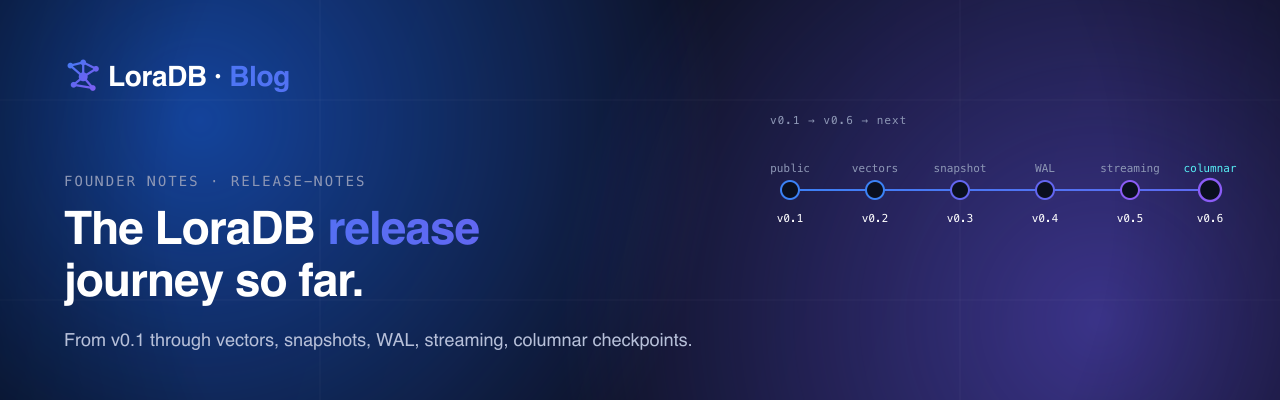
LoraDB has moved quickly since the public release, so it is worth stepping back from the version numbers and looking at the journey.
The individual posts tell the detail of each release. This one is the map: why the releases landed in this order, what each one proved, and how the current work fits the long arc from "fast local graph engine" to "database people can trust in the product loop."
v0.1: Make The Core Public
The first public release made the bet visible.
LoraDB shipped as a Rust in-memory graph database with a Cypher-shaped query engine, an HTTP server, and early bindings. The important part was not that every database feature existed. It was that the core pipeline was there and readable:
- parse;
- analyze;
- plan;
- execute;
- store graph values;
- return results through Rust, HTTP, and bindings.
That release set the product tone. LoraDB would earn trust locally before asking anyone to trust a hosted platform.
v0.2: Put Vectors Inside The Graph
The second release added first-class VECTOR values.
That was not a pivot into being a vector database. It was the opposite: an argument that embeddings are more useful when they live next to labels, properties, and relationships.
Similarity can find candidates. The graph can explain, filter, and rank them with context. v0.2 made that possible in one value model and one Cypher surface, across the bindings.
v0.3: Save The Graph
v0.3 added manual snapshots.
That sounds small until you look at the trust boundary it creates. Before snapshots, LoraDB was a fast in-memory graph that disappeared with the process. After snapshots, a developer could carry graph state across sessions, ship a seed file, back up a notebook, or restore a service from one artifact.
Snapshots were not marketed as full durability. They were deliberately point-in-time persistence. That honesty mattered because the snapshot contract became the base for checkpoints later.
v0.4: Recover Committed Writes
v0.4 added the WAL.
This is where persistence became continuous on filesystem-backed surfaces. Committed writes could be replayed after restart, torn log tails could be handled, and the server gained admin routes for checkpointing and WAL management.
The story changed from "save when you decide" to "recover what committed." Snapshots stayed important. They became the thing a WAL can checkpoint against.
v0.5: Stream The Query Path
v0.5 shifted attention from durability to flow.
The pull-based executor, owned query streams, client stream APIs, property indexes, and memory indexing work all point at the same product feeling: the database should not force large graph work through one oversized materialized response.
That is a necessary step for a local-first graph engine. If LoraDB is going to sit close to applications, it has to hand results to those applications in a shape they can process naturally.
The v0.5 patch releases also tightened WAL persistence edges. That is how trust accumulates: feature, use, fix, repeat.
v0.6: Turn Persistence Into A System
v0.6 upgraded snapshots into the current columnar LORACOL1 format and
connected them more tightly to WAL checkpoints.
This is the release where the persistence staircase became easy to explain:
- in-memory for the fastest local loop;
- snapshots for point-in-time graph artifacts;
- WAL for committed write recovery;
- checkpoint snapshots to bound replay.
The docs were refreshed around that model because old release notes can become dangerous if they teach old API names. The posts now preserve the history while pointing readers at the current shape.
Current Work: Make The Hot Path Concurrent
The latest commits after v0.6 continue the same thread.
Plan caching reduces repeated parse/analyze/compile work. Lock-free reads
via an ArcSwap snapshot store make reads cheaper under concurrency.
Arc-wrapped records make snapshot clones less expensive. Optimistic writes,
per-record validation, a lock table, mutation write sets, and merge replay
move the write path toward finer-grained concurrency.
The refactors that followed are not cosmetic. Splitting large modules in the store, database, WAL, snapshot, parser, analyzer, executor, server, and bindings makes the next round of performance work less risky. A system gets faster when its parts are easier to reason about.
The Pattern
The release pattern is now visible:
- Make the developer loop good. In-memory, readable, local, Cypher-shaped.
- Add the value model people need. Vectors belong in the graph when context matters.
- Add persistence one honest contract at a time. Snapshot first, WAL second, checkpoints after both are clear.
- Improve execution flow. Stream rows, index common lookups, avoid unnecessary materialization.
- Harden concurrency and structure. Make reads cheap, writes safer, and internals easier to change without breaking the product surface.
That pattern matters more than any single feature. It is how LoraDB keeps the product journey coherent while the engine grows quickly.
What Readers Should Take Away
LoraDB is not trying to jump straight from a public repo to a hosted graph cloud by announcement.
It is building the trust layers in order:
- can I understand it;
- can I query it;
- can I store the values my workload needs;
- can I save and recover it;
- can I stream results;
- can it stay fast under concurrent use;
- can someone else operate it for me later.
That is the journey of LoraDB so far. The next releases should keep making that journey easier to follow, not just longer.