The LoraDB team
Engineering

Engineering posts from the people building LoraDB — release notes, architecture pieces, and design writing on the in-memory property-graph engine, the Cypher pipeline, and the runtime surfaces (Rust, Node.js, Python, WASM, Go, Ruby, HTTP).

View all authors

LoraDB v0.15: benchmarks in public

· 6 min read
The LoraDB team
Engineering

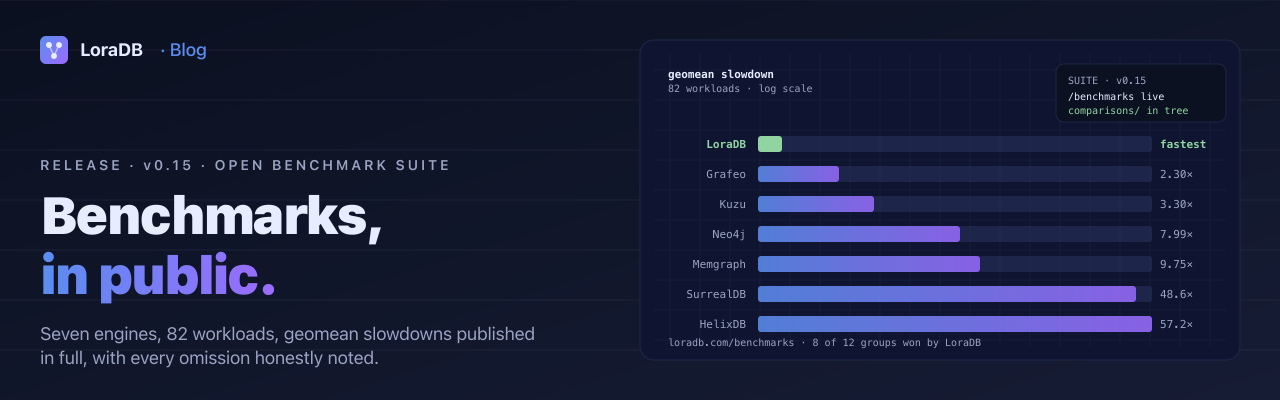
LoraDB v0.15. Benchmarks, in public.

LoraDB v0.15 publishes the numbers.

For most of the release journey the only benchmarks people saw were our internal smoke gates: a fixed set of workloads, a baseline, and "don't regress." That's enough to keep the engine honest with itself. It says nothing about how LoraDB compares to the other embedded and server graph engines a reader might already be using.

v0.15 closes that gap. The comparisons/ crate that drives the head-to-head suite is now in tree. The full report is committed at comparisons/report.md. A new /benchmarks page renders that report with per-engine ranking, per-group breakdowns, and a head-to-head page per competitor. Every workload that was skipped on a given engine carries the reason next to it.
LoraDB v0.14: hot paths and honest errors

· 10 min read
The LoraDB team
Engineering

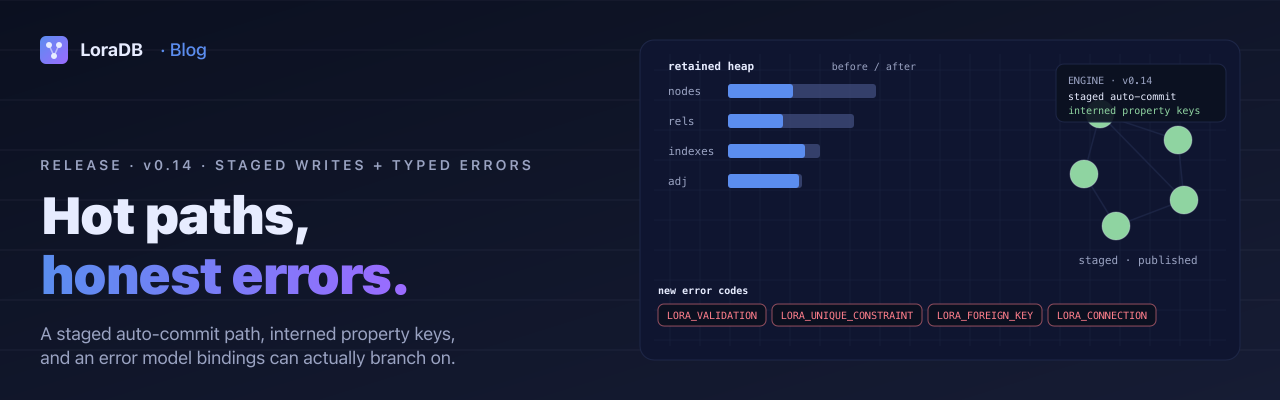
LoraDB v0.14. Hot paths, honest errors.

LoraDB v0.14 is a hardening release.

v0.11 put the engine behind a URL. v0.12 turned vectors into real indexes. v0.13 made data round-trip. v0.14 goes back to the engine and tightens three things that previous releases let slide: the write path, retained memory on large imports, and what an error actually says when something fails.

LoraDB v0.13: Rows in, graph out

· 8 min read
The LoraDB team
Engineering

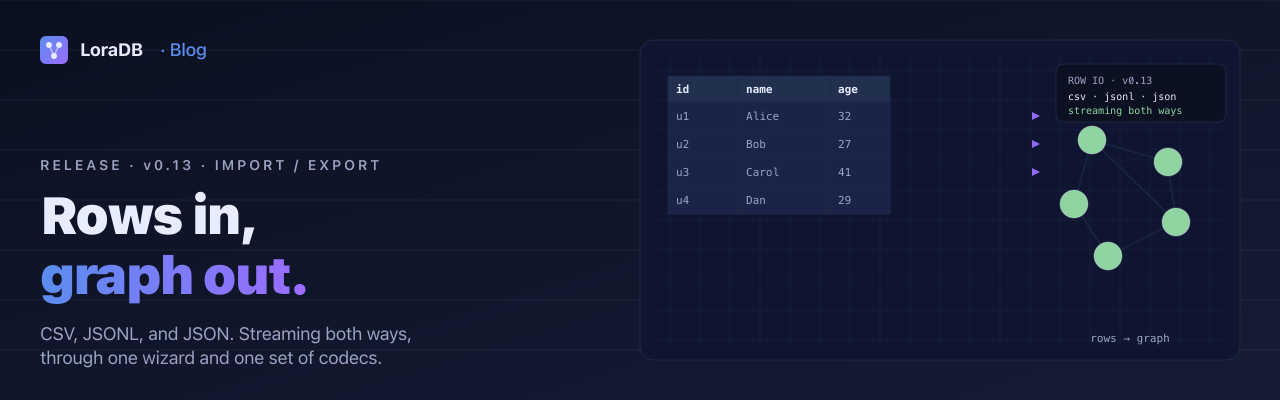
LoraDB v0.13. Rows in, graph out.

LoraDB v0.13 is an import / export release.

v0.5 made the engine stream. v0.6 made persistence feel like a system. v0.7 was a process release. v0.8 made plans and runtime metrics easier to inspect. v0.9 gave the planner a schema catalog. v0.10 made the function library a library. v0.11 put the engine behind a URL at play.loradb.com. v0.12 turned vectors into real indexes.

v0.13 turns the playground from a write-only sandbox into something you can put real data into. There is a new crate for row-level codecs, a bulk import / export driver in lora-database, three formats sharing one lossless value model, and a wizard that walks the whole pipeline from "drop a file" to "rows in the graph."

LoraDB v0.12: Vectors, end to end

· 8 min read
The LoraDB team
Engineering

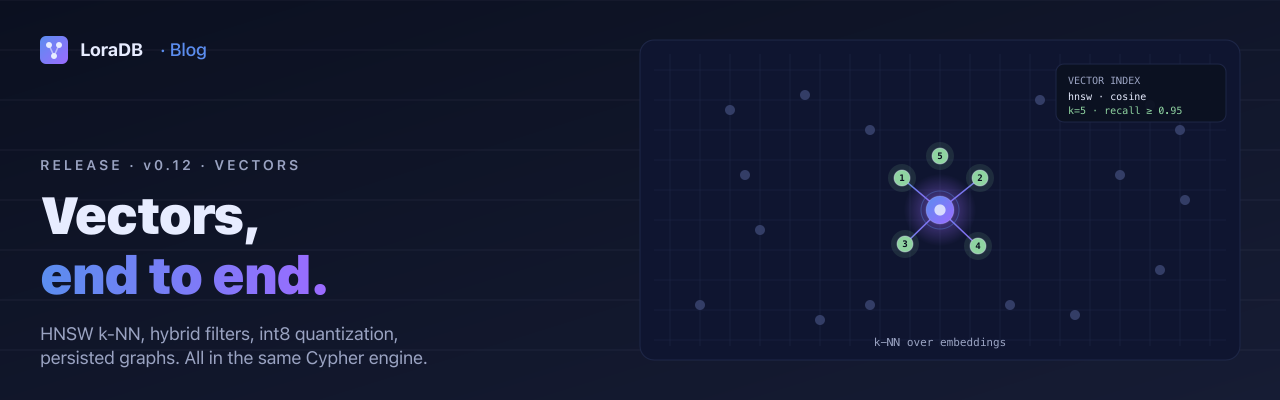
LoraDB v0.12. Vectors, end to end.

LoraDB v0.12 is a vector release.

v0.5 made the engine stream. v0.6 made persistence feel like a system. v0.7 was a process release. v0.8 made plans and runtime metrics easier to inspect. v0.9 gave the planner a schema catalog. v0.10 made the function library a library. v0.11 put the engine behind a URL at play.loradb.com.

v0.12 turns the vector type into a real index. Until this release a VECTOR value was a first-class property you could store, score, and return, but CREATE VECTOR INDEX was a catalog entry with no backing structure. Every k-NN query did a flat scan over every label-matching node. v0.12 keeps that behaviour as a deliberate fallback and adds an HNSW backend, hybrid pre-filters, four similarity metrics, int8 quantization, async populate, and snapshot persistence behind it. The playground gets a tuning wizard so none of this requires reading the catalog by hand.

LoraDB v0.11: Query playground in your browser

· 6 min read
The LoraDB team
Engineering

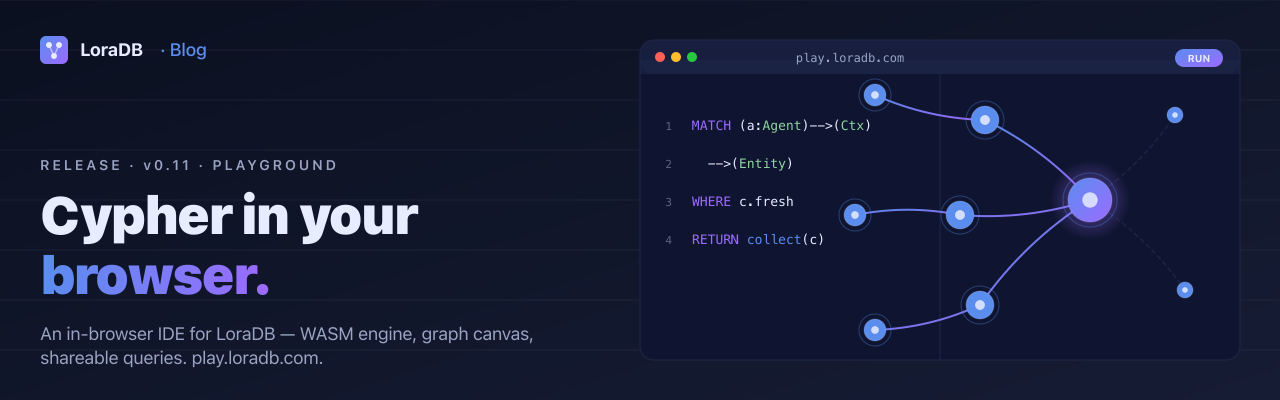
LoraDB v0.11 — query playground in your browser.

LoraDB v0.11 is a surface release.

v0.5 made the engine stream. v0.6 made persistence feel like a system. v0.7 was a process release. v0.8 made plans and runtime metrics easier to inspect from bindings. v0.9 gave the planner a schema catalog. v0.10 made the function library a library.

v0.11 puts the engine behind a URL. play.loradb.com is a browser playground for writing LoraDB queries, running them against an in-tab database, and seeing the results as a graph, table, or JSON. It ships as a static Next.js export and runs the database through WebAssembly in the browser.

LoraDB v0.10: one canonical name per concept

· 10 min read
The LoraDB team
Engineering

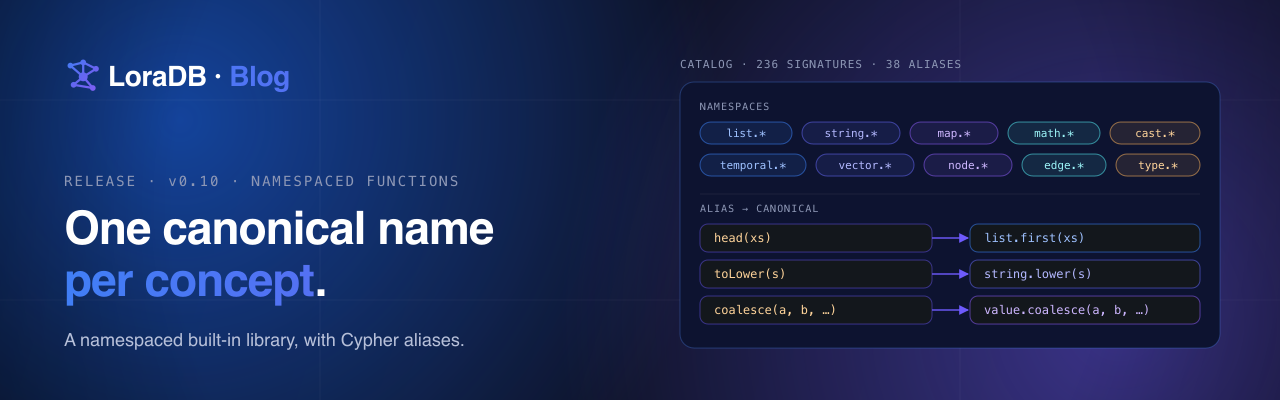
LoraDB v0.10 — one canonical name per concept.

LoraDB v0.10 is a function-surface release.

v0.5 made the engine stream. v0.6 made persistence feel like a system. v0.7 was a process release. v0.8 made the planner and executor observable. v0.9 gave the planner a real schema catalog.

v0.10 does the same thing for the function library: the engine now has one canonical name per concept, grouped into namespaces, with the analyzer, executor, optimizer, docs, and binding tests all reading from the same table.

LoraDB v0.9: indexes, constraints, and a real schema catalog

· 8 min read
The LoraDB team
Engineering

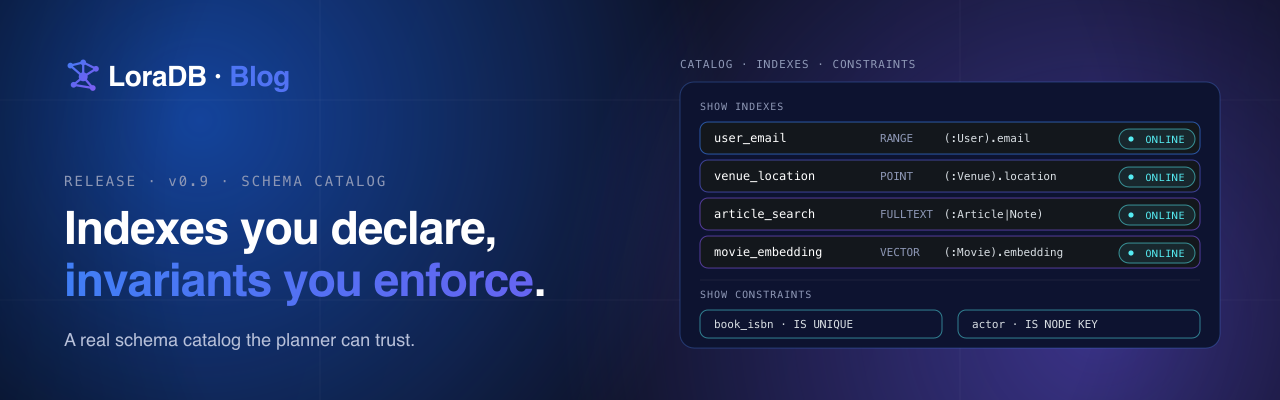
LoraDB v0.9 — indexes, constraints, and a real schema catalog.

LoraDB v0.9 is a schema-catalog release.

v0.5 made the engine stream. v0.6 made persistence feel like a system. v0.7 was a process release. v0.8 made the planner and executor observable. v0.9 closes the next gap: the planner now has a real schema catalog to plan against, and the engine has real constraints to enforce.

The result is a single coherent surface — index DDL, constraint DDL, catalog-backed scans, full-text and vector query procedures — wired through the parser, store, optimizer, executor, WAL, and snapshots.

LoraDB v0.8: explain, profile, and faster bindings

· 5 min read
The LoraDB team
Engineering

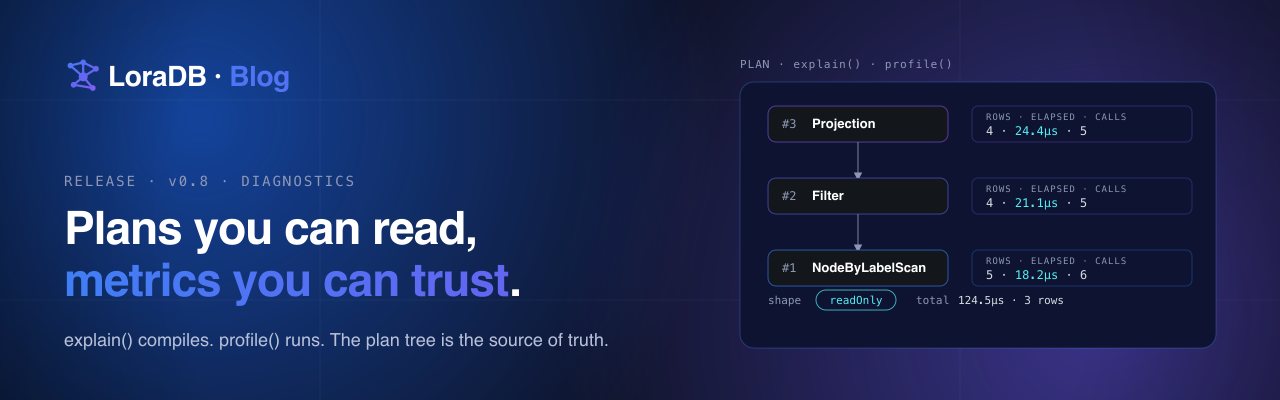
LoraDB v0.8 — explain() compiles, profile() runs, the plan tree is the source of truth.

LoraDB v0.8 is a diagnostics release.

Until now, the only honest answer to "why is this query slow?" was "read the executor source." v0.8 changes that. Every binding — Rust, Node, WASM, Python, Go, Ruby, FFI — and the HTTP server now expose explain and profile as first-class methods, returning the same plan tree the engine actually compiles and runs.

The release also includes binding-level speedups for bulk reads. That work is not the headline. The headline is that LoraDB queries are no longer opaque.

LoraDB v0.7: AI-assisted engineering, honestly

· 5 min read
The LoraDB team
Engineering

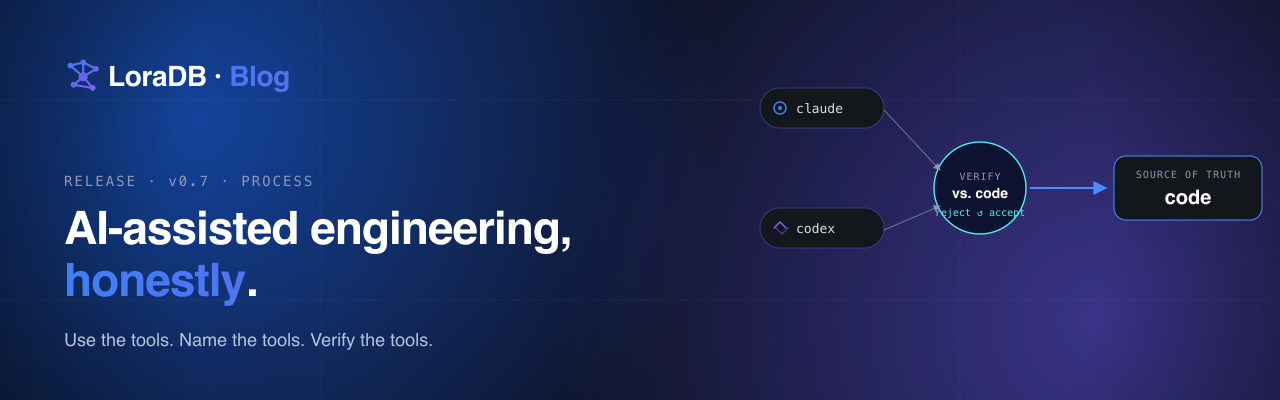
LoraDB v0.7 — AI-assisted engineering, honestly: use, name, verify the tools.

LoraDB v0.7 is about how the project is being built.

Claude and Codex are now part of the LoraDB engineering loop. Not as a mascot, not as a replacement team, and not as a way to avoid responsibility. They are used across the project: code review, refactoring, documentation, release work, architecture pressure, and product-direction thinking.

This release says that out loud.

The LoraDB release journey so far

· 5 min read
The LoraDB team
Engineering

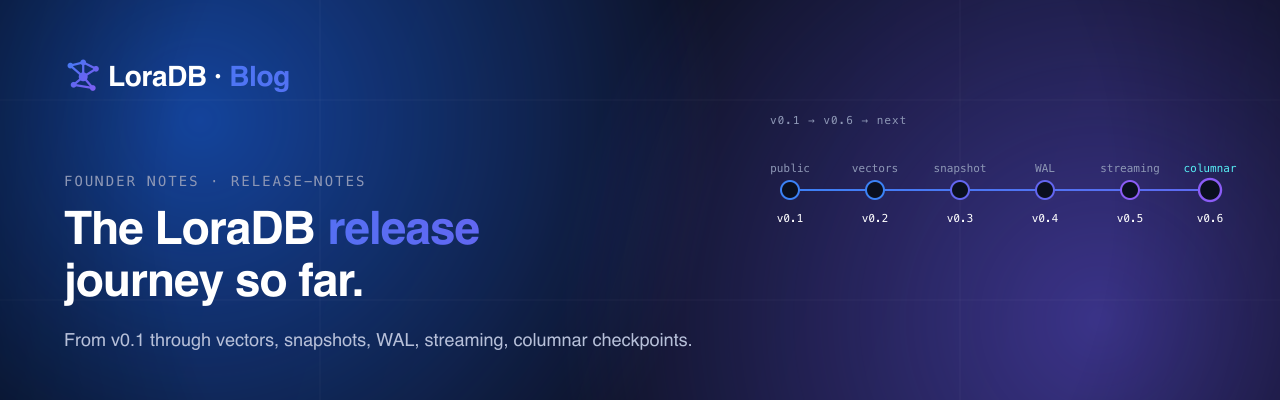
The LoraDB release journey — v0.1 through v0.6 milestones.

LoraDB has moved quickly since the public release, so it is worth stepping back from the version numbers and looking at the journey.

The individual posts tell the detail of each release. This one is the map: why the releases landed in this order, what each one proved, and how the current work fits the long arc from "fast local graph engine" to "database people can trust in the product loop."