LoraDB v0.9: indexes, constraints, and a real schema catalog

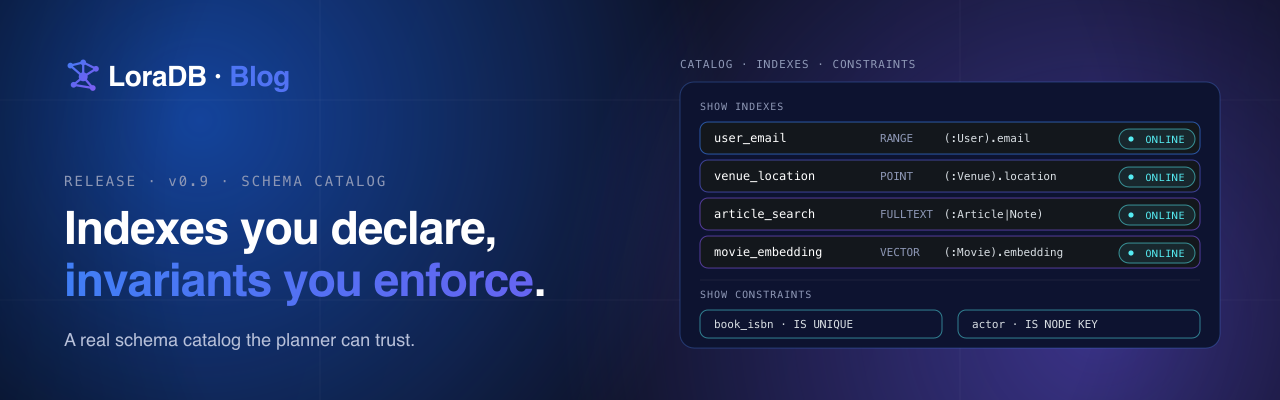
LoraDB v0.9 is a schema-catalog release.
v0.5 made the engine stream. v0.6 made persistence feel like a system. v0.7 was a process release. v0.8 made the planner and executor observable. v0.9 closes the next gap: the planner now has a real schema catalog to plan against, and the engine has real constraints to enforce.
The result is a single coherent surface — index DDL, constraint DDL, catalog-backed scans, full-text and vector query procedures — wired through the parser, store, optimizer, executor, WAL, and snapshots.
Not a shift away from schema-free graphs
LoraDB is still a schema-free property graph. Labels, relationship types, and properties continue to appear when you write them. v0.9 does not introduce a mandatory schema.
What it introduces is a way for developers to be explicit about two things:
- Keep a secondary structure for this hot predicate — that is an index.
- Reject writes that violate this invariant — that is a constraint.
Both are opt-in. A graph that never issues a CREATE INDEX or
CREATE CONSTRAINT keeps the v0.8 behavior unchanged.
Index DDL
Index management is now part of the Cypher surface:
CREATE INDEX user_email FOR (u:User) ON (u.email);
CREATE TEXT INDEX user_name FOR (u:User) ON (u.name);
CREATE POINT INDEX venue_location FOR (v:Venue) ON (v.location);
CREATE VECTOR INDEX movie_embedding FOR (m:Movie) ON (m.embedding)
OPTIONS {indexConfig: {`vector.dimensions`: 384, `vector.similarity_function`: 'cosine'}};
CREATE FULLTEXT INDEX article_search FOR (n:Article|Note) ON EACH [n.title, n.body];
CREATE INDEX rel_since FOR ()-[r:FOLLOWS]-() ON (r.since);

SHOW INDEXES;
SHOW VECTOR INDEXES;
DROP INDEX user_email IF EXISTS;
The supported catalog kinds are RANGE, TEXT, POINT, LOOKUP, VECTOR, and
FULLTEXT. RANGE is the default for CREATE INDEX; TEXT and POINT
activate dedicated string and spatial candidate registries; LOOKUP
records label/type token indexes in the catalog; VECTOR records a kNN
configuration; FULLTEXT builds an inverted index over one or more
properties.
IF NOT EXISTS is idempotent across both duplicate names and equivalent
index schemas. Duplicate names surface as 22N71, equivalent schemas
as 22N70, and dropping a missing index without IF EXISTS returns
42N51.
Constraint DDL
Schema constraints share the same surface:
CREATE CONSTRAINT book_isbn FOR (b:Book) REQUIRE b.isbn IS UNIQUE;
CREATE CONSTRAINT author_name FOR (a:Author) REQUIRE a.name IS NOT NULL;
CREATE CONSTRAINT actor_fullname FOR (a:Actor)
REQUIRE (a.first, a.last) IS NODE KEY;
CREATE CONSTRAINT movie_title FOR (m:Movie)
REQUIRE m.title IS :: STRING | LIST<STRING NOT NULL>;

SHOW CONSTRAINTS;
DROP CONSTRAINT book_isbn IF EXISTS;
The supported constraint family covers node and relationship uniqueness, existence, node keys, relationship keys, and property type constraints — including fixed-dimension VECTOR property types. Creating a constraint validates existing data before committing the catalog change; later writes are checked at mutation time.
Faster scan shapes
The optimizer now uses graph statistics and catalog state when it compiles a query. Eligible scan-and-filter patterns can lower to specialized operators:
NodeByPropertyScanandNodeByPropertyRangeScanNodeByTextScanNodeByPointScanRelByPropertyRangeScanRelByTextScanRelByPointScan
That covers node and relationship predicates such as:
MATCH (u:User) WHERE u.age >= 18 AND u.age < 65 RETURN u;
MATCH (u:User) WHERE u.name STARTS WITH 'Al' RETURN u;
MATCH (v:Venue)
WHERE geo.within_bbox(v.location, $southwest, $northeast)
RETURN v;
MATCH ()-[r:FOLLOWS]->() WHERE r.since > 2020 RETURN r;
The executor still refilters conservative candidate sets. TEXT indexes use a trigram candidate path, and POINT indexes use spatial buckets, so correctness does not depend on the index being exact.
Run the same query through profile() (shipped in v0.8) before and
after a CREATE INDEX to see the plan rewrite for itself.
Search procedures
Two catalog-backed procedure families are now exposed through the limited built-in procedure dispatcher.
Full-text indexes support node and relationship scopes, multiple labels or relationship types, and multiple indexed properties:
CREATE FULLTEXT INDEX article_search
FOR (n:Article|Note) ON EACH [n.title, n.body]
OPTIONS {`fulltext.analyzer`: 'standard'};

CALL db.index.fulltext.queryNodes('article_search', 'graph powerful')
YIELD node, score;
The standard analyzer lowercases text, splits on non-alphanumeric
boundaries, uses AND semantics across query terms, and scores by summed
term frequency. It returns rows in descending score order. It is
deliberately small: analyzer choice is currently limited to standard
and simple, both on the same synchronous maintenance path.
Vector indexes support node and relationship scopes with explicit
dimensions and either cosine or euclidean similarity:
CREATE VECTOR INDEX movie_embedding FOR (m:Movie) ON (m.embedding)
OPTIONS {indexConfig: {`vector.dimensions`: 3, `vector.similarity_function`: 'cosine'}};

CALL db.index.vector.queryNodes('movie_embedding', 5, [1.0, 0.0, 0.0])
YIELD node, score;
This is not an ANN engine yet. VECTOR indexes are catalog entries that
validate configuration and scope the query procedure; the current
implementation still uses a flat scan over matching entities and
returns the top k rows by score. The shape is stable; the speedup is
a later release.
Durability and snapshots
Index and constraint DDL travel through the same write path as graph
mutations. WAL payloads now encode CreateIndex, DropIndex,
CreateConstraint, and DropConstraint events, and recovery replays
them into the in-memory catalog before queries run.
Snapshots also carry both catalogs. The LORACOL1 envelope remains
format version 2, and the snapshot body is now version 4: version 3
added the index-catalog trailer, and version 4 adds the
constraint-catalog trailer. Readers still accept older body formats,
loading older snapshots with empty index or constraint lists as
needed.
The snapshot and WAL codecs now use a small store-owned binary codec for nested property values and catalog records. That keeps WAL and snapshots aligned on the same catalog wire shape, including VECTOR/FULLTEXT index definitions and constraint property-type records.
Developer-facing improvements
Planner APIs now accept GraphStats, and the plan cache fingerprints
catalog and cardinality state so adding or dropping an index
invalidates stale plans. That means a query explained before
CREATE INDEX can recompile into an indexed scan immediately after the
catalog changes.
Read-only materialization also gained an optional native parallel
feature through Rayon. It is default-on for native builds and disabled
for WASM-style consumers through default-features = false.
SHOW INDEXES now accepts type filters such as SHOW RANGE INDEXES,
SHOW FULLTEXT INDEXES, and SHOW VECTOR INDEXES. SHOW INDEXES and
SHOW CONSTRAINTS also accept a YIELD-anchored projection tail:
SHOW INDEXES
YIELD name, type, entityType
WHERE type = 'FULLTEXT'
RETURN name
ORDER BY name;
Benchmark coverage was reshaped around intent:
query_implementationsmirrors integration-test feature areas;index_accelerationcompares indexed and unindexed RANGE/TEXT scenarios;- existing
scale,realistic,wal,concurrent, andconcurrency_guardsuites remain workload-specific tools.
Breaking changes and migration notes
For Rust callers of lora-compiler, Compiler::compile now requires a
&GraphStats argument:
let compiled = Compiler::compile(&resolved, &store.graph_stats());
Use GraphStats::default() when compiling outside a store-backed
runtime.
Snapshot writers now emit the newer LORACOL1 envelope/body
combination. Current readers accept the previous body version, but
older binaries should not be expected to read snapshots written after
the index and constraint catalog trailers landed.
There are no data-model migrations for normal users. Existing graphs remain schema-free; add indexes where predicates are hot enough to justify the extra memory, and add constraints only for invariants you want enforced on every matching write.
Notable fixes
- Plan-cache invalidation now accounts for catalog/cardinality changes.
- Index and constraint catalog DDL survives WAL crash recovery.
- TEXT and POINT indexes track property updates and label/type membership changes.
- FULLTEXT indexes backfill existing data and track property updates/removals.
- Constraint-owned backing indexes cannot be dropped directly; use
DROP CONSTRAINTso the catalogs stay in sync. - Indexed scans preserve already-bound node and relationship variables instead of rebinding them.
- Regex predicates cache compiled patterns per thread, avoiding
repeated compilation for row-by-row
=~filters. - Numeric conversion helpers now reject non-finite or out-of-range float-to-int conversions instead of silently casting.
- Ruby binding calls release the GVL more defensively and surface engine panics as query errors.
How v0.9 fits the journey
v0.5 made the engine stream. v0.6 made persistence feel like a system. v0.7 was a process release. v0.8 made the planner and executor observable.
v0.9 closes the last gap before the planner stops being a black box:
the catalog. Indexes were already inferable from the code; constraints
were not enforceable at all. v0.9 gives both a stable surface — Cypher
DDL, WAL events, snapshot trailers, and SHOW introspection — that
every binding inherits without per-language plumbing.
Still open
This work does not add ANN structures for vector search, custom
full-text analyzers, a full-text query language, general
CALL/RETURN procedure pipelines, or sorted-index ORDER BY
planning. Composite RANGE indexes are accepted and visible in
SHOW INDEXES, but current optimizer rewrites target single-property
predicates. Those are the natural extensions of the v0.9 shape, not
prerequisites for it.
Read next
- Indexes — Cypher reference
- Constraints — Cypher reference
- Vector values and similarity functions
- Limitations
v0.9 is the release where LoraDB's planner stops guessing at structure that already exists in the application's head.