3 posts tagged with "Cypher"

Query language walkthroughs and patterns.

View All Tags

LoraDB v0.2: vector values for connected AI context

· 10 min read
The LoraDB team
Engineering

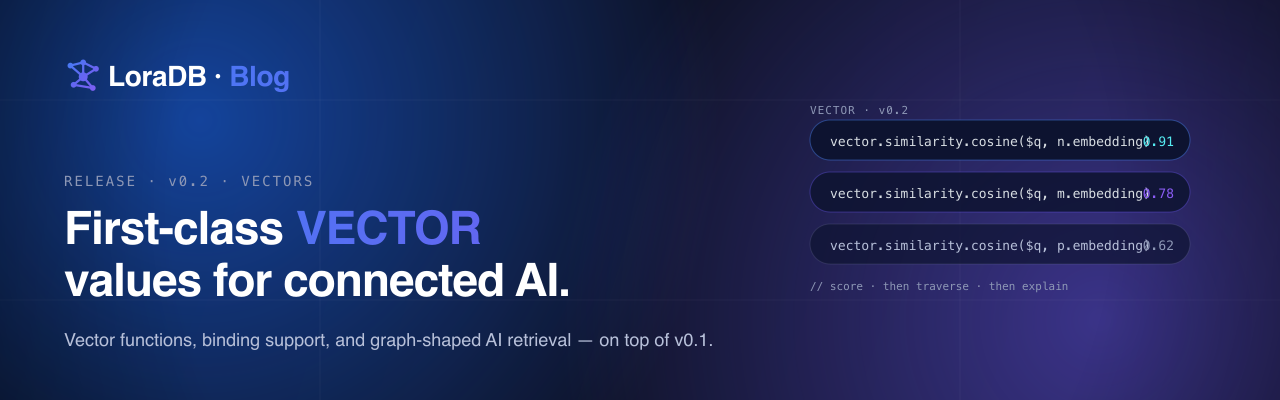
LoraDB v0.2 adds first-class VECTOR values.

You can now construct vectors in Cypher, store them as node or relationship properties, pass them in as parameters through every binding, and run exhaustive similarity search against them. The value type, the wire format, the function surface, and the binding helpers all landed together so vectors behave like every other typed value in the engine.

What this release is not is a vector-index product. There is no approximate nearest-neighbour search, no built-in embedding generation, and no plugin compatibility layer. Those are deliberately out of scope for v0.2. The goal here is to make embeddings comfortable inside the graph model — to ship the foundation that an index-backed retrieval path will eventually sit on.

Vectors belong next to relationships

· 9 min read
Joost van Berkel
Author, LoraDB

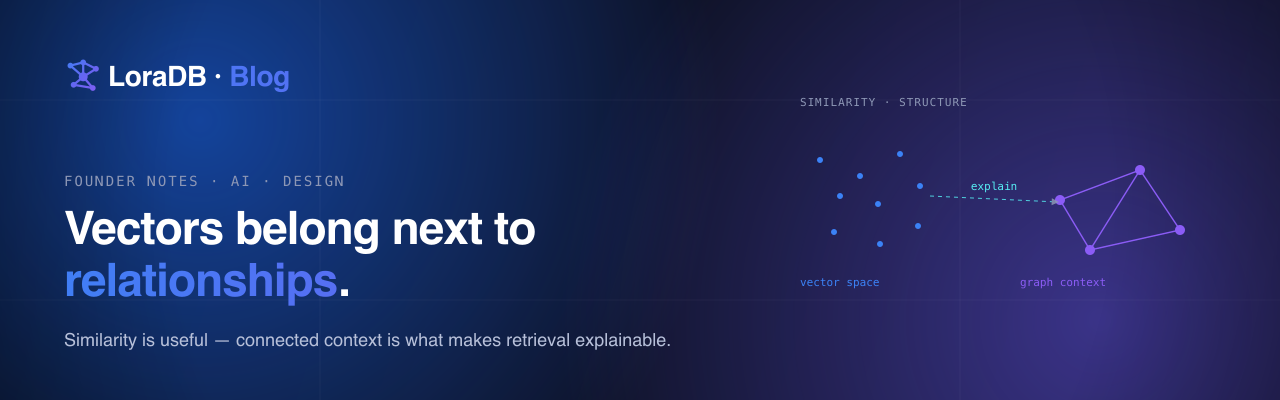
The conventional advice for AI retrieval is to pick a side.

You pick a vector database if you want similarity. You pick a graph database if you want structure. You bolt them together with glue code when the product inevitably needs both.

That framing has never matched the workloads I actually care about. The interesting systems — agent memory, recommendations, internal search over connected product data, knowledge graphs that feed chat features — do not want a vector store or a graph store. They want to retrieve candidates by similarity, then explain and filter those candidates by relationships. Splitting that into two products splits the query path, the data model, and eventually the team.

LoraDB v0.2 adds VECTOR as a first-class value type. Vectors live directly on nodes and relationships, next to labels, properties, and edges. The argument is not that a graph database should replace a vector database. The argument is that similarity belongs next to the relationships that give it meaning.

LoraDB public release: a fast in-memory graph database in Rust

· 7 min read
The LoraDB team
Engineering

LoraDB is now public.

It is a fast in-memory graph database written in Rust, with a Cypher-shaped query engine, an HTTP API, and bindings for Node.js, WebAssembly, and Python. It is built for developers who need relationship queries close to their application without adopting a large graph database stack on day one.

This release is the beginning of the public journey: source-available core, developer-first adoption, and a path toward a hosted platform for teams that want managed operations later.