LoraDB v0.12: Vectors, end to end

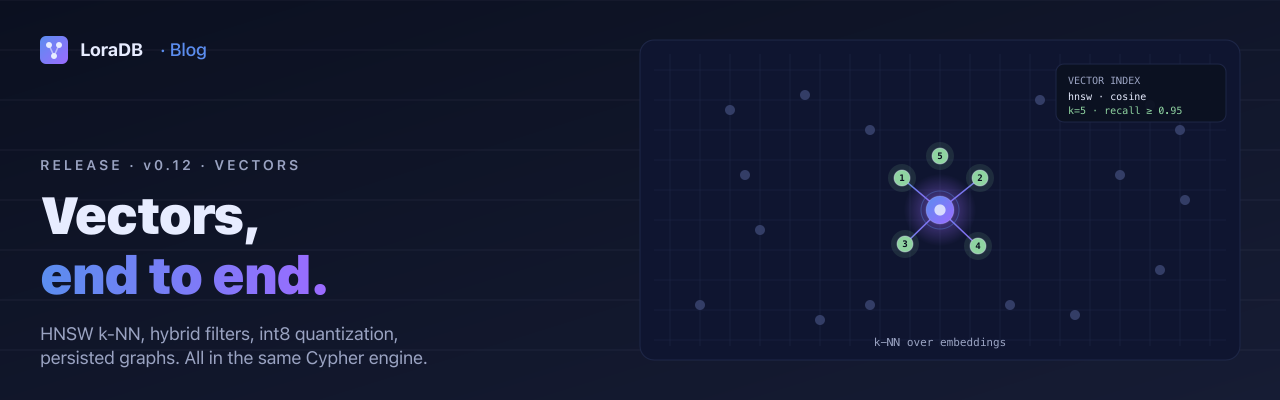
LoraDB v0.12 is a vector release.
v0.5 made the engine stream. v0.6 made persistence feel like a system. v0.7 was a process release. v0.8 made plans and runtime metrics easier to inspect. v0.9 gave the planner a schema catalog. v0.10 made the function library a library. v0.11 put the engine behind a URL at play.loradb.com.
v0.12 turns the vector type into a real index. Until this release a
VECTOR value was a first-class property you could store, score, and
return, but CREATE VECTOR INDEX was a catalog entry with no backing
structure. Every k-NN query did a flat scan over every label-matching
node. v0.12 keeps that behaviour as a deliberate fallback and adds an
HNSW backend, hybrid pre-filters, four similarity metrics, int8
quantization, async populate, and snapshot persistence behind it. The
playground gets a tuning wizard so none of this requires reading the
catalog by hand.
What ships
The work is structured as five phases. Each one is shippable on its own. The release is the union.
A real index, not just a catalog entry
CREATE VECTOR INDEX registers a backend that lives alongside the
property store. Writes flow through the same secondary-index
maintenance hook that already serves TEXT, POINT, and FULLTEXT, so a
SET n.embedding = ... updates the vector index in lockstep. Queries
go through GraphStorage::vector_search, not a per-call scan of the
node store.
The default backend is still flat scan, which scores every vector on
every query. It is correct, deterministic, and the right pick under
about ten thousand vectors. The phase-1 refactor by itself shaved
about 25% off the cost of CALL db.index.vector.queryNodes at
n=1,000, d=384 because the backend reads a pre-built map instead of
chasing label index then Arc<NodeRecord> then property lookup for
every entity.
HNSW for sub-linear k-NN
CREATE VECTOR INDEX movie_emb FOR (m:Movie) ON (m.embedding)
OPTIONS {indexConfig: {
  `vector.dimensions`: 384,
  `vector.similarity_function`: 'cosine',
  `vector.indexProvider`: 'hnsw'
}}
The HNSW backend is hand-rolled. No new dependency. The implementation follows Malkov and Yashunin (2018) with the simple closest-M neighbour selection. Defaults match the names used by Neo4j so existing configs port without surprise:
vector.hnsw.m: 16vector.hnsw.ef_construction: 200vector.hnsw.ef_search: 100
At n=10,000, d=384, k=10, cosine, the bench measured 4.38 ms per query for flat and 1.19 ms for HNSW: a 3.7x speedup. The gap widens with N because flat is O(N) and HNSW is roughly O(log N).
Per-index level assignment is seeded from the index name, so a snapshot reload reproduces the same graph topology and the same top-k. Recall against the flat oracle holds at 0.95 or higher on uniform random embeddings at d=64 with default knobs.
Four similarity metrics
vector.similarity_function accepts cosine, euclidean, dot,
and manhattan. Cosine and euclidean are unchanged from prior
releases. Dot product is added for normalised embeddings (one
reciprocal-sqrt cheaper per pair). Manhattan uses 1 / (1 + d_L1)
for the same higher-is-better shape as euclidean.
The HNSW backend works with every metric for free. The algorithm
operates on -similarity internally and inherits whichever scoring
function the catalog records.
Hybrid queries
The procedure grew an optional fourth argument:
CALL db.index.vector.queryNodes(
  'movie_emb',
  10,
  $queryVec,
  {restrictTo: [1, 5, 12, 47]}
) YIELD node, score
RETURN node, score
The flat backend skips non-allowed ids during scoring. HNSW keeps
non-allowed ids as routing hops, because evicting them would
fragment the graph, but excludes them from the result heap. Under a
filter, internal ef auto-bumps to keep recall stable when the
filter is selective. Users facing very tight filters should still
raise vector.hnsw.ef_search at index creation.
Pre-computing the candidate set with a normal MATCH + collect
is currently a two-step pattern: the standalone-CALL router does
not yet thread through WITH. That integration is the next item on
the planner side.
int8 quantization for HNSW
OPTIONS {indexConfig: {
  ...
  `vector.hnsw.quantization`: 'int8'
}}
Each f32 coordinate is scaled by 127 and stored as INTEGER8. The
query vector is quantized the same way at search time. Storage drops
by 4x for the vector portion of an HNSW index.
The current implementation accepts int8 only with cosine. Cosine
is scale-invariant, so the implicit ×127 scaling preserves ranking
exactly. Euclidean and manhattan are not, and would return a
degenerate score range, so the schema validator rejects the
combination at DDL time rather than silently mis-ranking.
Async populate
OPTIONS {indexConfig: {
  ...
  `vector.populate.async`: true
}}
When set, the index registers in Populating state and CREATE
returns immediately. The first query against the index triggers the
backfill inline, then flips the state to Online. Mutations between
CREATE and the first query already flow through the maintenance
hook, so nothing is dropped: the lazy phase only handles vectors
that existed before CREATE.
This trades initial-query latency for CREATE latency. It is the
right pick when you have a script that creates the index alongside
other work and does not query it for a while.
Snapshot persistence
HNSW pays an O(n log n) cost to rebuild. v0.12 captures the entire backend in the snapshot trailer: nodes, layered neighbour lists, entry point, RNG state, and quantization config. On load, the restore overlays the persisted topology after the catalog re-registers the index. Older snapshots round-trip cleanly through the existing rebuild path.
A round-trip test confirms a donor HNSW returns byte-identical
top-k ids in the same order after save_snapshot_to_bytes and
load_snapshot_from_bytes. That is the strongest signal that the
rebuild path was bypassed, because a rebuild would produce a
different graph topology under a different RNG seed.
The trailer is JSON-encoded for v0.12. The length-prefixed framing is stable, so a future binary codec can drop in without bumping the snapshot format version.
A wizard for all of this
In the playground, the Add index flow now ships a Tune step
that appears only when the kind is VECTOR. It exposes every
option the engine accepts:
- a
NumberInputfor dimensions, clamped to 1..4096, with a hint pointing at common embedding widths (384 for MiniLM, 768 for BERT-base, 1536 for OpenAI text-embedding-3-small) - a segmented control for similarity, with a one-line tradeoff blurb per choice
- a segmented control for provider (HNSW or flat)
- three marked sliders for M, efConstruction, efSearch
- an int8 quantization switch that auto-disables itself with a tooltip when combined with a non-cosine metric
- an async populate switch
- a
Quick readpanel that summarises the active tuning in plain language as the user changes knobs
Editing an existing vector index round-trips its tuning so users never lose their config.
SHOW INDEXES now surfaces the full OPTIONS map as a column so
the same panel can list the active configuration in the index
inspector.
Same engine, not a separate path
The vector index pipeline is not a sidecar. It uses:
- the same
LoraVectorvalue model that powered scoring and storage since v0.5, - the same
IndexCatalogthat holds TEXT, POINT, FULLTEXT, and RANGE entries, - the same
secondary_index_maintenancehook that already keeps trigram and grid indexes in lockstep with the property store, - the same
GraphStoragetrait surface used by every Cypher read path, - the same snapshot codec used by the rest of the catalog.
The trait that adds vector_search has a default that returns an
empty vector, so backends without HNSW support degrade to "no
results" cleanly. The procedure parser, the schema validator, and
the playground wizard all share one source of truth for what the
options map can contain.
What is deferred
A few things from the design plan are not in v0.12 and are flagged as Phase 6 follow-ups in the issue tracker:
- Planner pushdown so
WITH ids CALL ...can thread an id set into the procedure without a textual hack. - Hand-rolled binary codec for the snapshot trailer (today it is JSON-encoded inside a length-prefixed bytes block).
- The HNSW heuristic neighbour selection from Algorithm 4 of the paper. Recall on uniform data is fine without it; clustered data may benefit.
- Quantization for euclidean and manhattan, which needs a different storage encoding than the scale-invariant cosine trick.
Try it
cargo add lora-database
Or open play.loradb.com and click Add index in the schema panel. Pick Vector similarity, fill in a
label and property, accept the defaults on the Tune step, and the
generated DDL appears in the preview before you commit it.
The full changelog and binaries are on the v0.12.0 release page.